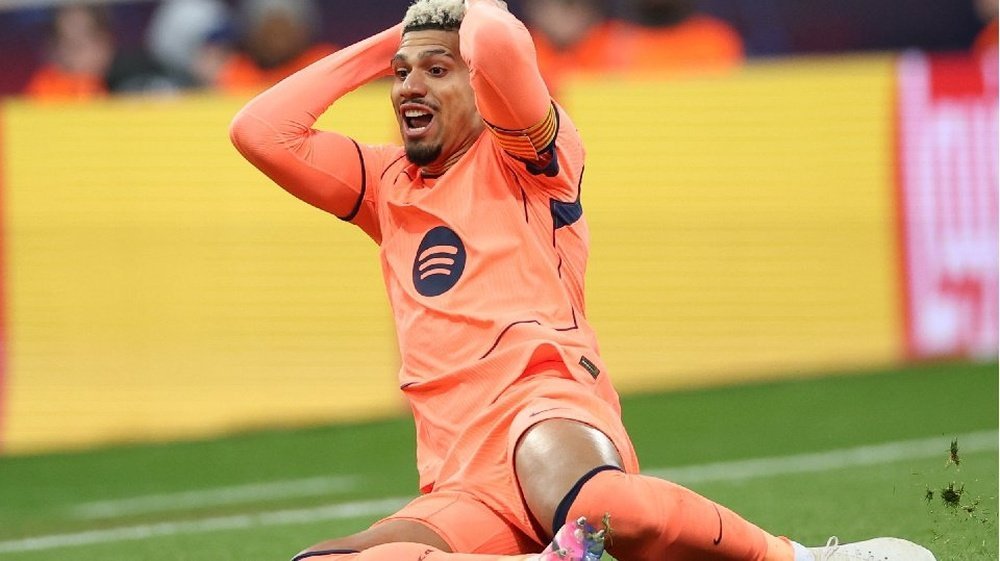
Defenders are often judged in seconds, and during the recent UEFA Champions League clash between Newcastle United and FC Barcelona, one brief moment placed Uruguayan center-back Ronald Araújo at the center of intense debate.
The match, played in England as part of the knockout stage, ended in a 1–1 draw, but the opening goal sparked criticism toward Araújo after television replays appeared to show the defender reacting slowly while Newcastle built the move that led to the breakthrough.
Soon after the game, however, Araújo offered an explanation that shed light on a confusing sequence involving injuries, refereeing instructions, and a split-second decision that ultimately shaped the play.
The moment that sparked criticism
Newcastle took the lead through English winger Harvey Barnes, who finished a well-constructed attack after receiving a precise pass from Jacob Murphy.
Barnes found himself with space near the edge of the penalty area before firing a shot that beat Barcelona’s defense and gave the home side the advantage.
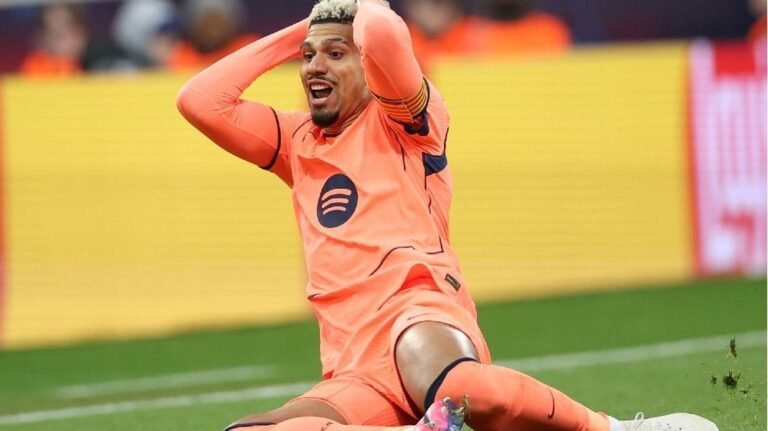
What immediately caught the attention of viewers and analysts was Araújo’s positioning. Cameras showed the defender several meters away from the play, jogging back while the attack unfolded, which led many observers to question why he did not close down the space earlier.
A confusing sequence behind the play
According to Araújo, the situation was far more complicated than it appeared on screen.
Just moments before the goal, the Barcelona defender had fallen behind the goal line after suffering severe muscle cramps. While he tried to regain his footing and return to his defensive position, Italian referee Marco Guida instructed him to leave the field temporarily.
The confusion came when Newcastle quickly restarted the play.
Araújo explained that he believed he was allowed to remain on the pitch despite the cramps, even if he was momentarily unable to move at full speed. Instead, he was told to exit the field and re-enter from the touchline or goal line area.
By the time he attempted to return, the attacking move was already underway.
“I didn’t understand the rule in that moment,” Araújo later said in a television interview. “If I have cramps, I thought I could stay on the field, even standing or walking. I don’t know why I was forced to leave. Once that happened, it was impossible to recover the position in time.”
Tactical impact on Barcelona’s defense
From a tactical perspective, Barcelona’s defensive structure was temporarily disrupted during that sequence.
Araújo is normally one of the key organizers of the team’s back line. His absence for those few seconds created a gap that Newcastle exploited with speed and precision. Murphy advanced the ball and quickly found Barnes in space, leaving Barcelona’s defense scrambling to recover.
The play illustrated how even a brief moment of disorganization can be decisive at the highest level of European football.
A mature response from the Barcelona squad
Despite the setback, Araújo emphasized that Barcelona handled the situation with greater composure than in previous difficult matches.
The Uruguayan defender pointed out that the team had learned from its recent elimination in the domestic cup against Atlético Madrid, where a heavy first-leg defeat left them chasing an almost impossible comeback.
“This time we managed the game more intelligently,” he said. “We didn’t play the football we wanted, but we stayed calm and kept the tie open.”
The defender also acknowledged that Barcelona’s original strategy had been to dominate possession and apply more pressure in attack. However, Newcastle’s intensity and the atmosphere inside the stadium made that plan difficult to execute.
A decisive second leg awaits
With the first leg finishing level, the outcome of the tie will now be decided at Barcelona’s home stadium, the Spotify Camp Nou.
Araújo expressed confidence that the team can deliver a stronger performance with the support of their fans, noting that Champions League knockout ties often hinge on how teams manage pressure across both matches.
He also addressed concerns about the physical condition of the squad, explaining that Barcelona players have faced a demanding schedule filled with high-intensity games in recent weeks.
Despite the cramps that affected him during the match, Araújo said he personally felt ready to compete and was pleased to be back in the starting lineup.
A reminder of football’s fine margins
Moments like the one involving Araújo highlight how thin the line can be between criticism and understanding in elite football.
A split-second decision, a misunderstanding with the referee, or even a brief injury can dramatically influence the outcome of a match. In competitions like the Champions League, those details often determine whether a team advances or falls short.
As Barcelona prepares for the decisive second leg, the controversy surrounding Araújo’s moment may fade — replaced by the much bigger question: which club will ultimately move on in Europe’s most prestigious tournament?