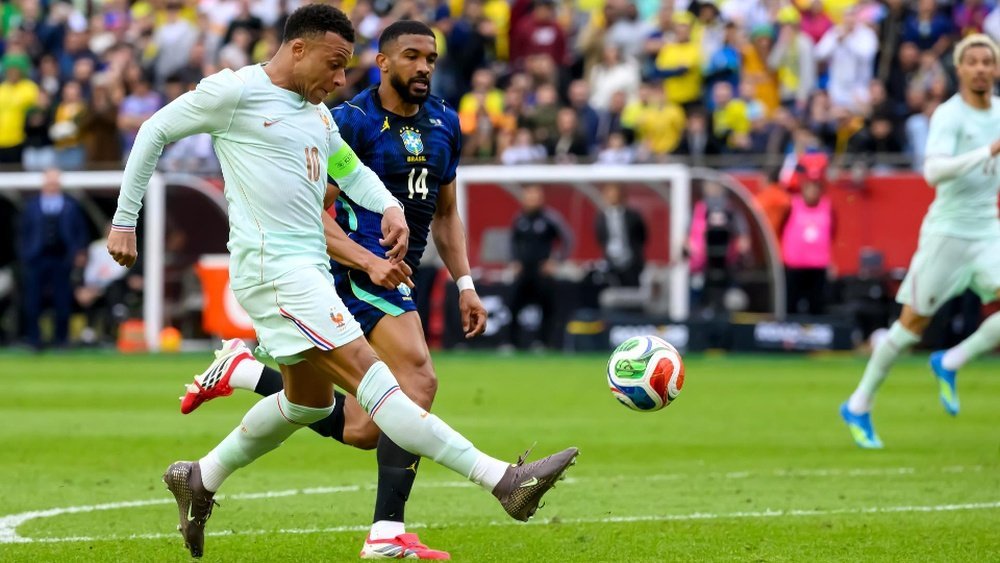
In a high-intensity international friendly ahead of the 2026 FIFA World Cup, the Brazil national football team suffered a frustrating 2-1 defeat against the France national football team, despite playing with a numerical advantage for a significant portion of the second half.
The match, played with the atmosphere and intensity of a competitive fixture, exposed both the potential and the vulnerabilities of a Brazilian side still searching for consistency under pressure.
From the opening minutes, Brazil attempted to impose their rhythm, with Raphinha testing the French defense early with a long-range effort that narrowly missed the target. France responded calmly, showing composure in possession and gradually growing into the game.
As the first half unfolded, chances came at both ends, but it was Kylian Mbappé who once again proved decisive. In the 31st minute, the French captain picked up the ball near midfield, accelerated past defenders, and finished with remarkable precision, lifting the ball over the advancing goalkeeper to give France the lead.
Brazil struggled to respond effectively before halftime. Despite moments of promise from Vinícius Júnior and Gabriel Martinelli, the team lacked sharpness in the final third, while France appeared more dangerous whenever they pushed forward.
The second half brought a dramatic shift. Brazil returned with greater urgency, increasing their attacking tempo and forcing France deeper into their own half. The turning point came early when Dayot Upamecano was sent off after a VAR review upgraded his initial yellow card to a red, leaving France with ten men.
With the numerical advantage, expectations rose for a Brazilian comeback. However, what followed highlighted a recurring issue: dominance without efficiency. Brazil controlled possession, pushed forward, and created pressure—but lacked the clinical edge required to capitalize.
Instead, it was France who struck again. In the 64th minute, Michael Olise delivered a precise pass that split the Brazilian defense, allowing Hugo Ekitiké to finish calmly and double the lead—an outcome that stunned the Brazilian bench.
To their credit, Brazil did not collapse. The team continued to push forward, and their persistence was finally rewarded when Gleison Bremer found the net after a well-worked sequence involving Casemiro and Luiz Henrique. The goal reignited hope and set up a tense final stretch.
In the closing minutes, Brazil threw everything forward. Crosses, set pieces, and long-range efforts tested the French defense, but the equalizer never came. France, despite being a man down, demonstrated resilience, discipline, and tactical maturity to protect their lead until the final whistle.
Beyond the result, the match offers deeper insights. For Brazil, the inability to convert numerical superiority into goals raises concerns about decision-making, composure, and attacking efficiency—key elements that must improve before the World Cup.
For France, the victory reinforces their status as one of the most complete and dangerous teams in international football. Even under pressure and reduced numbers, they showed an ability to adapt, defend, and strike with precision.
As both nations continue their preparations for 2026, this encounter may prove more significant than a simple friendly. It served as a tactical test, a psychological challenge, and a clear reminder that at the highest level, control means little without execution. (por : futnews24)